
Paper club opens with a session on coordination in multi-agent systems
Download the slides (PDF) Download the brochure (PDF)
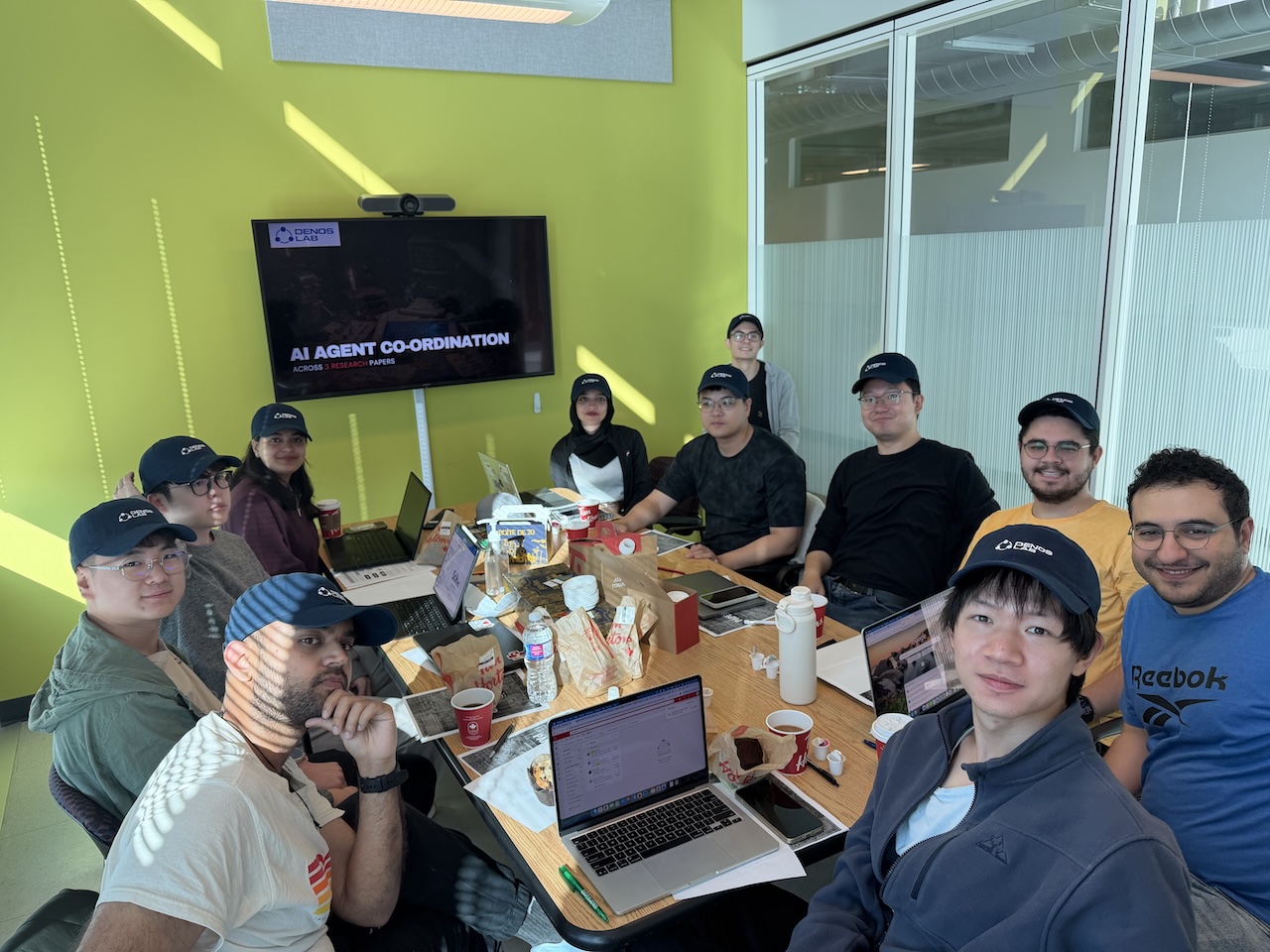
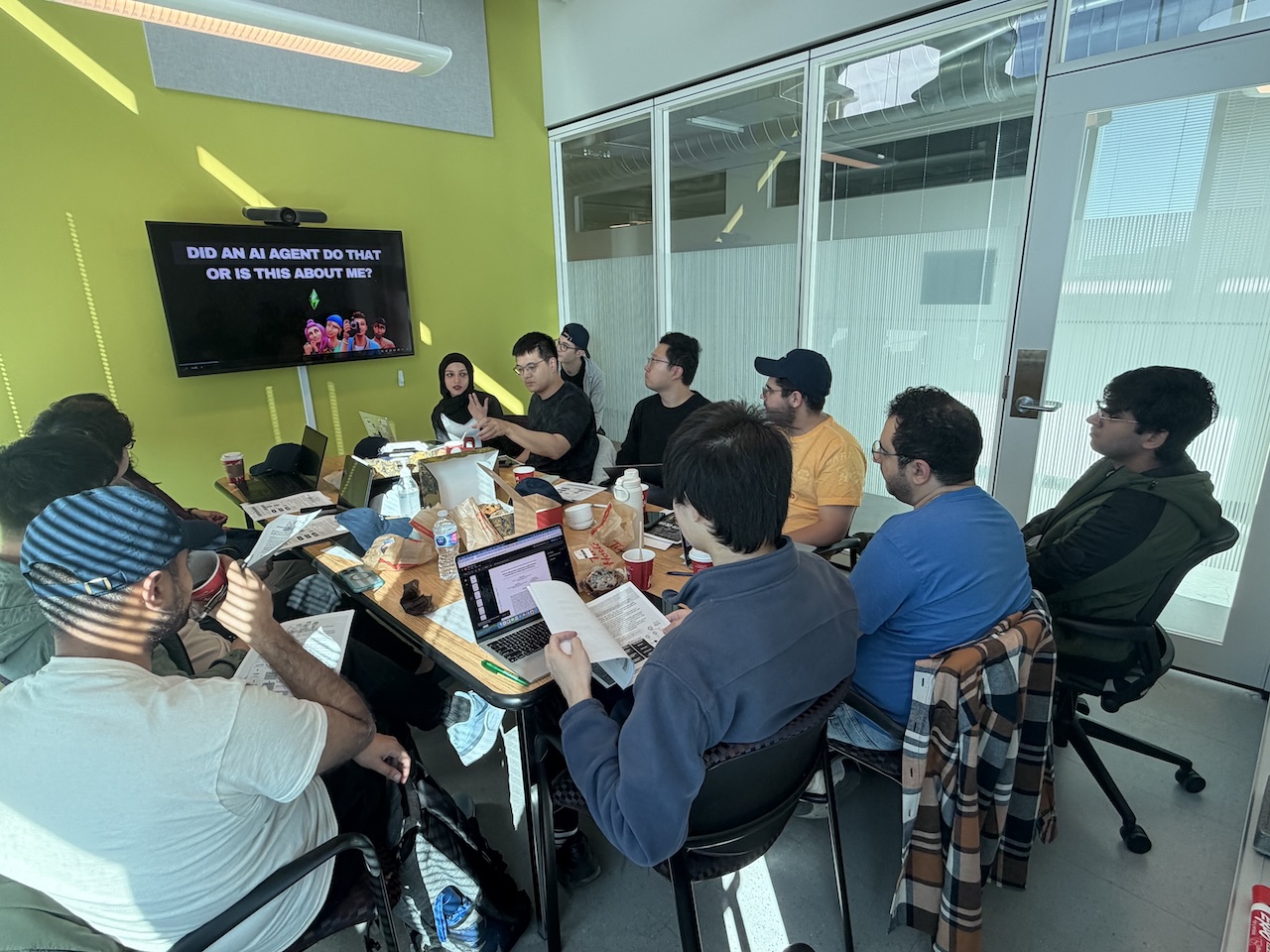
The DENOS Lab paper club held its first session on September 18, 2026, a student-initiated reading group in which lab members take turns presenting a set of papers and the room works through the ideas together. Haniya Farhan, a 2026 Mitacs Globalink Research Internship student at the lab, opened the series with a session titled AI Agent Co-ordination Across 3 Research Papers. Around a dozen lab members filled the meeting room in matching DENOS Lab caps, with coffee and a box of Timbits on the table, and Haniya handed out a five-page brochure she had prepared so that everyone could follow the three architectures on paper while she walked through them on the screen.
The session opened with a question that set the tone for the morning, did an AI agent do that or is this about me. Haniya described three familiar failures, an agent that retrieves only fragments of a memory, an agent that starts saying random things to a stranger, and an agent that loses the thread of what it was asked, and then argued that all three are infrastructure problems rather than model problems. Large language models fail at sustained multi-agent work because they are missing memory, coordination, and execution structure, and each of the three papers is an architectural response to one of those gaps.
The first paper was Generative Agents: Interactive Simulacra of Human Behavior, which populates the Smallville sandbox with 25 agents that perceive, plan, act, and reflect. Haniya spent most of her time on the memory stream, a natural language log of everything an agent experiences, and on the retrieval score that weighs recency by exponential decay, importance by an integer the model assigns from 1 to 10, and relevance by the cosine similarity of memory embeddings. Reflection kicks in when accumulated importance crosses a threshold and synthesizes higher level insights, and plans decompose from a day to an hour to actions of five to fifteen minutes. Her takeaway was that believable long-horizon agents are not just about a better model, they need a memory architecture that decides what to remember, what to infer, and when to act. A one-minute group exercise asked the room to work out why the underground water tunnels in Hawaii were giving out pickle flavoured water, a playful way to feel how quickly a chain of agents can wander.
That led into the second paper, MetaGPT: Meta Programming for a Multi-Agent Collaborative Framework. Naively chained models suffer from what Haniya called the telephone game, where small hallucinations compound at every hop until the last agent is working from a distorted picture of the task. MetaGPT encodes human standard operating procedures as roles, a product manager writing a requirements document, an architect producing the system design, a project manager listing tasks per file, an engineer writing code, and a QA engineer writing unit tests. Agents exchange fixed-schema artifacts rather than free-form chat, publish to a shared message pool, and activate only when every prerequisite has arrived, and an executable feedback loop runs the tests and debugs up to three times. The group looked at the comparison against ChatDev, where MetaGPT scored 3.75 against 2.25 on executability, used 124.3 tokens per line against 248.9, and needed 0.83 revisions against 2.5. The point Haniya drew out was that structure is not a constraint on model creativity, it is what makes a multi-agent system reliable enough to ship.
The third paper, HALO: Hierarchical Autonomous Logic-Oriented Orchestration for Multi-Agent LLM Systems, takes aim at the fixed roles that make MetaGPT brittle outside software. A planning agent decomposes the query into subtasks and passes the history forward, a role-design agent generates agent profiles on the fly for each subtask, and a Monte Carlo tree search coordinates the low-level inference agents. Haniya walked through the four steps of the search, selection with the UCB1 rule, expansion by spawning a new agent at the frontier, evaluation by a language model judge that scores each node, and backpropagation of that score to every ancestor, so that good reasoning paths are chosen more often next time. The same architecture handles code generation on HumanEval, general reasoning on MMLU, and arithmetic on MATH without task-specific engineering, and the lesson was to treat a multi-agent workflow as a search problem rather than a fixed pipeline.
The closing comparison in the brochure lined the three systems up by memory, coordination, roles, task execution, domain, and key limit. Generative Agents has persistent memory and emergent coordination but is expensive to run, MetaGPT has structured artifacts and a fixed pipeline but breaks outside software, and HALO has dynamic roles and search but starts every query from scratch. That last row became the discussion for the rest of the session. None of the three systems learn across runs, so performance resets to zero on every new task, and until agents can accumulate and transfer knowledge over time the architecture is sophisticated but the system is still disposable. For a lab that builds agentic simulations of emergency departments and evacuations and puts agent harnesses in front of federated analytics, that gap is close to home, and the conversation ran well past the last slide.
Haniya’s slides and the brochure she prepared for the session are available to download. Thank you, Haniya, for setting the bar for the sessions to come, and to everyone who turned up to argue about it.