
Working with Calgary Emergency Medicine Data Lab to Showcase Our Research
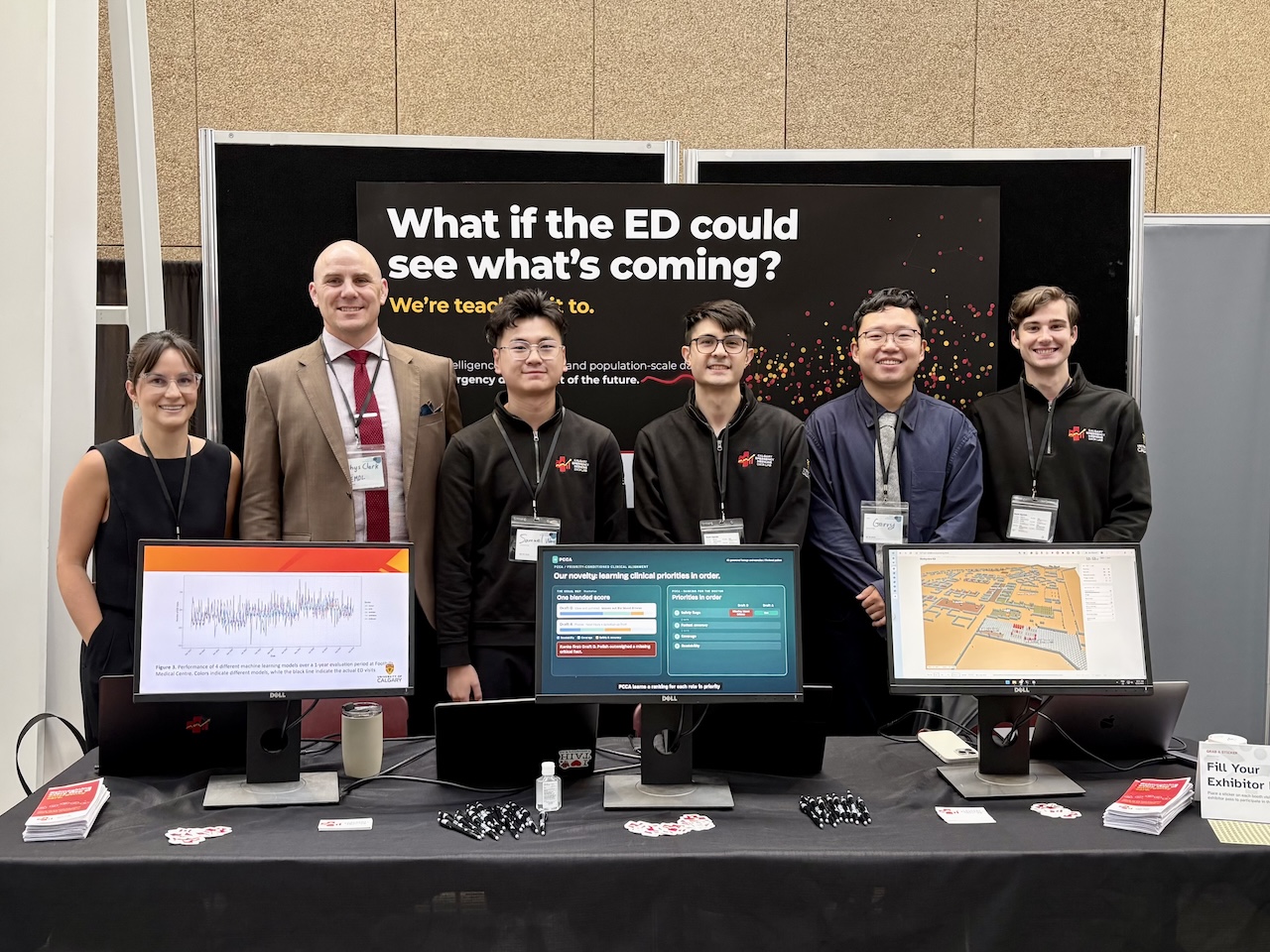
CALGARY. What if the emergency department could see what is coming? That was the question on the banner as University of Calgary researchers set up shop at the University of Calgary’s Foothills Campus on Tuesday to show health workers and innovators how artificial intelligence is being taught to do exactly that.
DENOS Lab PhD candidate Gerry Wu was at the Calgary Emergency Medicine Data Lab (CEMDL) booth alongside Alexander Burn and Samuel Wang, joint members of DENOS Lab and CEMDL, for The Future of the OR: A Health Everywhere Hub Living Lab & Innovation Event, a day-long showcase in the HRIC Atrium organized by W21C, the health systems innovation centre based at the Cumming School of Medicine.
The two labs are co-developing multiple projects aimed at the front line of emergency care, and the ties run deeper than a shared table. Burn and Wang split their time between the engineering side at DENOS and the clinical data side at CEMDL. CEMDL is directed by Dr. Jessalyn Holodinsky, an Assistant Professor at the University of Calgary, and DENOS Lab is led by Dr. Steve Drew of the Schulich School of Engineering.
Visitors to the booth got a look at three of those projects running live, two of them on the middle screen. One is LENS, a role-aware multi-agent grading pipeline for clinical summaries in which the same summary is scored in parallel by three role-specific agents, a physician, a triage nurse, and a bedside nurse. Each role scores the summary across eight rubric dimensions on a one to five scale, and the system then computes a role-level weighted overall score, a cross-role overall score, and an Orchestrator Disagreement view that shows how far the three role scores differ on each dimension. Sharing that screen is Priority-Conditioned Clinical Alignment, a system that learns the order in which clinicians rank competing priorities and blends them into a single score.
The third is EDSim, the lab’s simulation of an emergency department floor in which autonomous agents play patients, nurses, and physicians so that staffing and triage changes can be tested before they reach a real patient.
Emergency departments across Alberta have been under sustained pressure, with long waits and crowded hallways a regular feature of the news. The researchers say the goal is not to replace the people doing the work but to give them a clearer picture of the shift ahead and a safe place to try changes.
The collaboration has already produced results. The EDSim team, which includes emergency physicians and researchers from both labs, has posted EDSim: An Agentic Simulator for Emergency Department Operations as a preprint, and the University of Calgary featured the work earlier this year.
Tuesday’s event brought together clinicians, hospital staff, industry, and researchers under the Health Everywhere Hub banner to look at where operating rooms and acute care are heading. For the students at the booth it was a chance to put their systems in front of the people who would use them and hear what an emergency department needs before the next shift starts.